From AI Tools to AI Systems: Why the Next Competitive Advantage Is Architecture

Updated: Aug 24
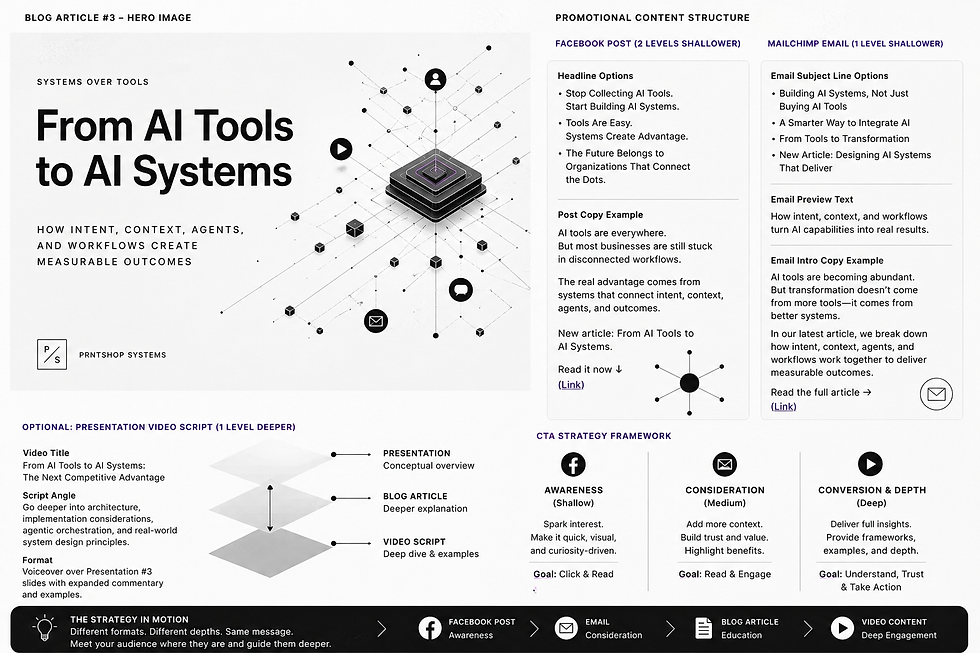
AI is no longer difficult to access. The difficult part is figuring out what to do with all of it.
There was a time when adopting artificial intelligence meant finding an AI tool.
You needed an image generator, so you found one.
You needed a chatbot, so you found one.
You needed an automation platform, a writing assistant, a transcription service, an analytics tool, or a code-generation environment—and increasingly, there is a seemingly endless supply of each.
That is a remarkable development.
It is also creating a new problem.
Businesses don't have an AI availability problem anymore. They have an AI coordination problem.
The question is no longer:
"Which AI tool should we use?"
The more important question is:
"How should these capabilities work together?"
And that distinction is going to become increasingly important.
The Tool Is Not the System
Imagine a marketing team using ten different AI applications.
One generates ideas.
Another writes copy.
Another creates images.
Another analyzes customer data.
Another schedules social posts.
Another produces video.
Another summarizes meetings.
Another manages automation.
Every tool may be excellent at what it does.
But if a human employee has to manually move information between all of them, reconcile their outputs, provide the missing context, make every decision, and remember what happened during the previous iteration, something important has been missed.
The business has adopted AI tools without actually building an AI system.
The tools are doing work.
The human is still doing the orchestration.
And orchestration is where an enormous amount of the potential leverage exists.
The Emerging AI Stack
A useful way to think about the emerging architecture is:
Intent → Agent → Skills → Tools → Data → Output
This isn't a rigid technical standard. It is a conceptual model for understanding how increasingly sophisticated AI workflows can be organized.
Intent
What are we actually trying to accomplish?
Not:
"Write an email."
But perhaps:
"Re-engage customers who haven't purchased in six months."
The second statement contains substantially more meaning.
It establishes an objective.
Agent
What entity is responsible for pursuing that objective?
An agent doesn't necessarily need to be an autonomous science-fiction character.
At a practical level, an agent can simply be a system capable of interpreting an objective, determining appropriate actions, and coordinating available capabilities.
Skills
What does the agent know how to do?
Research.
Analyze.
Write.
Classify.
Design.
Edit.
Plan.
Evaluate.
A skill is essentially a repeatable capability that can be applied in context.
Tools
What can actually perform the operation?
A database.
An API.
A spreadsheet.
A browser.
An image generator.
A CRM.
A code environment.
A publishing platform.
The distinction matters because knowing how to accomplish something isn't necessarily the same as possessing the mechanism for accomplishing it.
Data and Context
What does the system need to know before acting?
This is where many AI implementations become dramatically more useful.
The brand guidelines matter.
The customer history matters.
The previous campaign matters.
The current project matters.
The organization's policies matter.
The intended audience matters.
The surrounding circumstances matter.
Context turns capability into relevance.
Context Is the Missing Ingredient
Consider asking an AI:
"Write a product announcement."
It can do that.
Now provide:
the company's brand voice,
the product's positioning,
the target customer,
previous campaign performance,
the launch objective,
prohibited claims,
existing visual identity,
distribution channels,
and the desired conversion action.
The task hasn't necessarily become more complicated.
It has become better defined.
This is one of the fundamental shifts AI enables.
Instead of repeatedly explaining an organization to every tool, we can begin designing systems in which context persists around the work.
That changes the economics of AI.
The intelligence isn't merely in the model.
It emerges from the relationship between:
model + context + tools + objective + feedback.
Intent Is More Important Than Implementation
This leads to an even more interesting idea.
Suppose the objective is:
Create a successful product launch campaign.
There are hundreds of ways to accomplish that.
One organization might use email.
Another might prioritize social video.
Another might create an educational webinar.
Another might focus on SEO.
Another might build a community campaign.
A rigid automation system needs to be told which path to follow.
A more intelligent system can potentially begin with the objective and constraints, then determine which available capabilities are appropriate.
That creates a distinction between:
What we want
and
How we accomplish it.
That distinction may become one of the defining characteristics of AI-native systems.
From Automation to Adaptation
Traditional automation is extremely good at predictable processes.
For example:
When a form is submitted → add the contact to the CRM → send an email → notify the sales team.
That's useful.
But it is fundamentally a predetermined sequence.
AI introduces the possibility of workflows that operate more like:
Observe → Interpret → Decide → Act → Evaluate → Adapt
Now the system can potentially respond differently depending on what it encounters.
That doesn't mean humans disappear from the process.
Quite the opposite.
For serious business applications, human judgment, approval, accountability, and quality control remain extremely important.
But humans no longer necessarily have to micromanage every intermediate operation.
The system can handle more of the coordination.
One Objective. Many Implementations.
This may be the most important conceptual shift.
Imagine giving several AI systems the same objective:
Create a complete editorial publication about urban birdwatching for a general-interest audience.
They might produce radically different workflows.
One might begin with market research.
Another might begin by constructing a content architecture.
Another might identify search demand.
Another might generate visual concepts first.
Another might construct an editorial calendar.
They could all arrive at viable publications through different paths.
The objective remained stable.
The implementation changed.
That suggests an important principle for AI workflow design:
The more effectively a system can separate desired outcomes from implementation details, the more adaptable that system can become.
This doesn't mean removing constraints.
Constraints remain essential.
Brand standards.
Budget.
Deadlines.
Legal requirements.
Quality thresholds.
Available resources.
Those constraints define the acceptable solution space.
But within that space, AI can potentially explore different ways of accomplishing the objective.

See the Concept in Action ➡️
What happens when a complex system isn't presented as a collection of isolated features, but as an environment where rules, agents, capabilities, context, and outcomes interact?
We're experimenting with that question through Project Tengen, an interactive game concept designed as a visual exploration of complex systems.

This Changes How We Should Think About "AI Automation"
The phrase AI automation can be misleading.
It makes the technology sound like a more sophisticated version of a macro:
Do this. Then this. Then this.
The more interesting future may be closer to:
Here is what we're trying to accomplish. Here is the context. Here are the boundaries. Here are the capabilities available to you. Determine an appropriate path and show me the result.
That is not simply automation.
It is orchestration.
And eventually, it becomes something closer to system design.
The Real Competitive Advantage
This brings us back to the original question.
If everyone has access to increasingly capable AI models, what differentiates one organization from another?
Not necessarily access to the model.
Not necessarily the number of subscriptions.
Not necessarily who has discovered the newest prompt.
The advantage increasingly comes from how effectively the organization connects intelligence to its actual operations.
The organization that understands its workflows can identify where AI belongs.
The organization that understands its data can provide context.
The organization that understands its objectives can establish meaningful evaluation criteria.
The organization that understands its customers can determine what "good" actually means.
And the organization that connects all of those things can begin building systems rather than merely accumulating tools.
The Next Interface May Be Intent
For decades, software has largely required humans to learn how the software works.
Click this.
Open that.
Select this option.
Configure that setting.
AI begins reversing some of that relationship.
Instead of learning every mechanism, humans can increasingly describe what they want.
That doesn't eliminate interfaces.
It changes them.
The interface can become:
intent.
And the system becomes responsible for translating that intent into appropriate operations.
That is potentially a profound shift in how humans interact with software.
From Content Systems to Intelligent Systems
This is particularly relevant for marketing.
A modern content operation might involve:
Research
↓
Strategy
↓
Writing
↓
Design
↓
Editing
↓
Publishing
↓
Distribution
↓
Analytics
↓
Optimization
Each stage can now contain AI capabilities.
But the real opportunity isn't simply inserting an AI application into every box.
The opportunity is designing the relationships between the boxes.
What information moves forward?
What context persists?
Which decisions require human approval?
Which steps can be delegated?
What happens when something fails?
How does performance data affect the next iteration?
What does the system learn about the organization over time?
Those are architectural questions.
And architectural questions are where AI consulting becomes particularly valuable.
The Beginning of the AI-Native Organization
We are still early.
The tools are evolving rapidly.
The models are changing.
The interfaces are changing.
The boundaries between software applications are becoming increasingly fluid.
That makes this an unusually important moment for organizations to think beyond individual tools.
The question isn't:
"How do we use AI?"
It's:
"What should our organization look like if intelligence becomes an embedded capability throughout the system?"
That is a much bigger question.
And answering it doesn't begin with buying another AI subscription.
It begins with understanding the system you already have.
Then identifying where intelligence can be introduced.
Then connecting those capabilities into something greater than the individual parts.
Build the System, Not Just the Tool Stack.
AI is becoming abundant.
Context is becoming valuable.
Coordination is becoming strategic.
And the organizations that learn how to combine the three may discover that their greatest advantage isn't any single AI application.
It's the architecture connecting all of them.


Comments