How AI Is Reshaping Content Creation Pipelines

Updated: Jul 21
A System-Level Perspective from Tevan Lockhart Photography

Content creation is often framed as a daily task—something that requires consistency, effort, and constant ideation. But what if that framing is the problem?
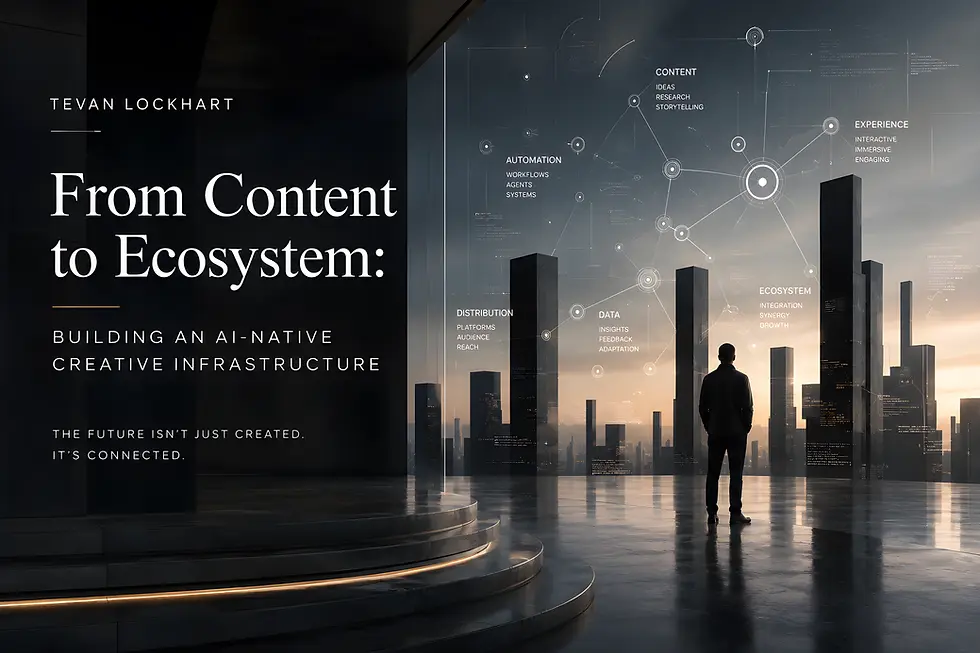
In a recent internal presentation, we explored a shift in perspective: moving away from content as isolated output, and toward content as the result of structured, repeatable systems.
This article documents that presentation and expands on its core ideas.
The Limitation of Traditional Content Creation
Most creators and businesses approach content manually:
Each post begins from scratch
Output depends on time, energy, and motivation
There is little structural continuity between pieces
This creates a fundamental bottleneck. When production relies on effort alone, scaling becomes difficult, and consistency becomes fragile.
Rather than a content issue, this is more accurately described as a systems issue.
From Output to Infrastructure
The key shift is conceptual:
Instead of asking:
“What should we create today?”
We begin asking:
“What system can produce content continuously?”
This re-framing moves content creation into the realm of infrastructure—something that can be designed, refined, and scaled.
Defining a Content Pipeline
A content pipeline is a structured process that transforms a single idea into multiple usable outputs.
At a high level, it consists of three core stages:
1. Input
Raw material:
Notes
Ideas
Conversations
Internal knowledge
2. Processing
Where structure is applied:
Organizing ideas
Expanding concepts
Translating into usable formats
This is where artificial intelligence becomes most valuable—not as a generator, but as a processor.
3. Output
Final assets:
Presentations
Video content
Blog articles
Social media clips
Email communications
Each output is not created independently. Instead, it is derived from the same structured source.
The Role of AI in the Pipeline
Artificial intelligence is commonly used to generate content directly. However, this approach only scratches the surface.
A more effective use is to position AI as a processing engine:
Converting unstructured ideas into structured formats
Maintaining consistency across outputs
Reducing friction in content transformation
This distinction is critical. The advantage is not in faster creation—it is in repeatable structure.
One Idea, Multiple Assets
When a pipeline is in place, a single concept can be expanded into a full ecosystem of content:
A presentation becomes the foundation
A recorded commentary becomes video content
Transcripts become written articles
Key segments become short-form clips
Insights become email communications
This is not an increase in workload. It is the result of a unified system producing multiple outputs from a single input.
Why Structure Outperforms Tools
Many workflows fail because they are built around tools rather than systems.
Tools evolve rapidly. Platforms change. Features are replaced.
Structure, however, remains stable.
A well-designed pipeline allows tools to be swapped without disrupting the overall process. This creates long-term resilience and scalability.
Compounding Output Over Time
With a functional pipeline:
Content production becomes consistent
A library of work begins to accumulate
Each new idea strengthens the overall system
Over time, this leads to compounding returns—not just in content volume, but in clarity, authority, and reach.
Looking Beneath the Surface
The presentation this article is based on outlines the visible layer of a larger system.
What remains less visible—but increasingly important—is how these pipelines can be layered, connected, and expanded into more advanced workflows.
This is where content transitions into infrastructure, and where simple processes begin to evolve into scalable systems.
Closing Thoughts
The future of content creation is not defined by volume alone, but by structure.
Organizations and creators who invest in building systems—rather than relying solely on effort—position themselves to scale more effectively, adapt more quickly, and produce with greater consistency.
This document represents an early step in that direction.
Further developments will continue to explore how these systems can be refined, connected, and extended over time.
This article is part of an ongoing exploration into content systems and workflow design. Additional breakdowns are shared periodically.


Comments